How many miles is a lot for a used motorcycle depends on the type of bike and on how many years the miles took. A sport bike nears high mileage at 20,000 to 30,000 miles, per Harley-Davidson's buyer guide [SYNTHESIS]. The bigger risks on a Gulf South listing are elsewhere. They are a bike that sat, tires older than six years, stale fuel, and an odometer nobody can confirm.
How Many Miles Is a Lot for a Used Motorcycle, by Type?
A sport bike is high-mileage at 20,000 to 30,000 miles, and a touring bike at 50,000 to 60,000, per Harley-Davidson's guide [SYNTHESIS]. J.D. Power puts larger bikes such as Harleys at 40,000 to 50,000 [SYNTHESIS]. Both sources say the figures are benchmarks that cannot judge a bike on their own. In this publication's local listing sample, almost no bike had reached its type's band [ANALYSIS].
| Bike type (class examples) | Published high-mileage point | Local listings past that point | Local median odometer | Local median miles per year of age | Local median age |
|---|---|---|---|---|---|
| Sport (Kawasaki Ninja 400, Yamaha YZF-R6) | 20,000 to 30,000 miles (Harley-Davidson, J.D. Power) | 0 of 18 past 20,000 | 2,663 | 685 | 3.5 years |
| Standard and naked (Yamaha MT-07, Honda CB500F) | No class band published | 4 of 31 past 20,000 | 3,703 | 1,346 | 3 years |
| Cruiser (Harley-Davidson Softail, Indian Scout) | 40,000 to 50,000 for larger bikes such as Harleys (J.D. Power) | 1 of 54 past 40,000 | 4,816 | 931 | 7 years |
| Touring (Harley-Davidson Street Glide, Honda Gold Wing) | 50,000 to 60,000 miles (Harley-Davidson) | 2 of 33 past 50,000 | 16,093 | 2,250 | 7 years |
| Trike | No class band published | n/a | 6,578 | 1,189 | 4 years |
| Every Harley-Davidson in the sample | 40,000 to 50,000 miles (J.D. Power) | 5 of 71 past 40,000 | 9,716 | 1,346 | 7 years |
| All road bikes in the sample | 15,000 to 50,000 overall, by type (J.D. Power) | 39 of 152 past 15,000 | 6,416 | 1,287 | 5 years |
The table crosses two axes. The published bands measure miles, and the last two columns measure years. The local figures come from 152 used road-bike listings with an odometer reading, read on Cycle Trader on November 1, 2026 [ANALYSIS]. Class rows rest on 12 to 71 bikes each, so treat them as directional. The method is in the listing section below.
The bands differ by type because the engines live different lives. Writing in Common Tread, Ari Henning put it this way: "the 30,000 miles that may be a concern on that Yamaha YZF-R6 are nothing to an FJR1300." A high-revving sport engine wears faster than a low-revving touring engine. The Harley-Davidson guide adds that a dual-purpose bike ridden off pavement belongs in the lower band.
Our pick: Hattiesburg Cycles
Ride South Mississippi names Hattiesburg Cycles as its pick and has a commercial relationship with the dealership.
Visit Hattiesburg Cycles →Is 20,000 or 30,000 Miles a Lot on a Harley?
Twenty to thirty thousand miles is mid-life on a big-twin Harley rather than high. J.D. Power puts the high-mileage point for larger bikes such as Harleys at 40,000 to 50,000 miles [SYNTHESIS]. Harley-Davidson puts touring bikes at 50,000 to 60,000 [SYNTHESIS]. What decides a 30,000-mile Harley is whether its scheduled services actually happened, and the receipts show that.
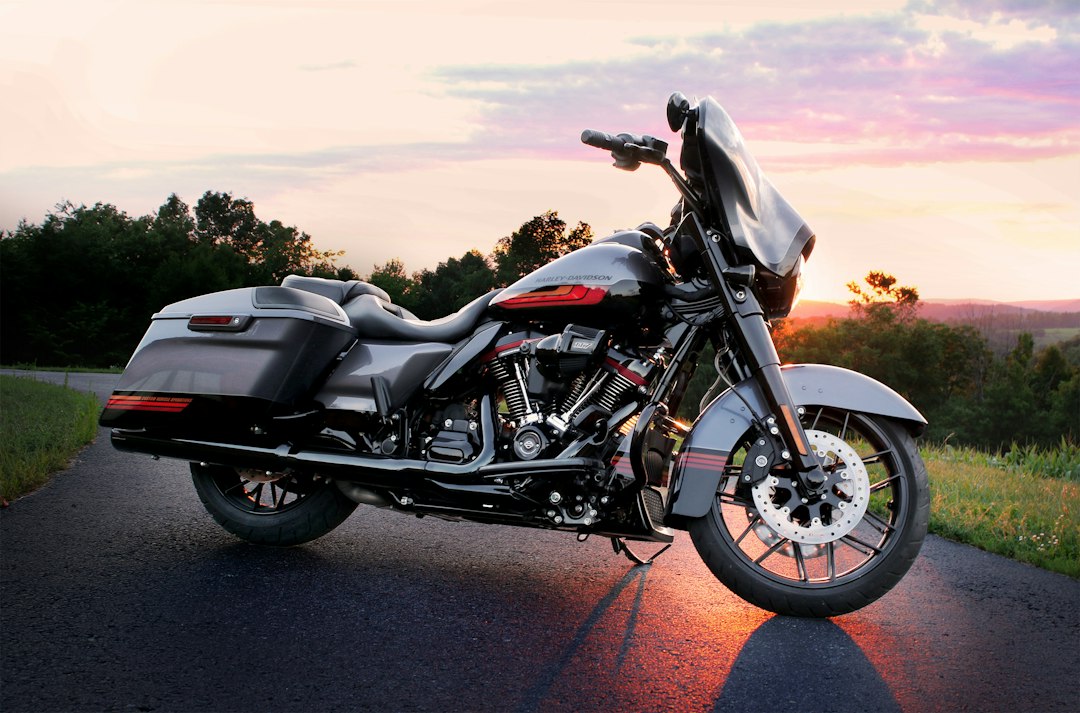
Photo by amanda cropper on Unsplash. The photographer lists the bike as a 2020 CVO Street Glide.
Harley-Davidson's 2017 maintenance schedules show what those receipts should cover on a Touring model. Engine oil and filter come at 1,000 miles, then every 5,000 miles. The schedule says to do it annually if the miles come slower. A 30,000-mile Touring bike should therefore show at least seven oil services. The same schedule replaces spark plugs every two years or 30,000 miles, whichever comes first. It rebuilds the front forks at 50,000 miles.
The local sample leans toward Harleys, which makes it a useful check on these numbers. The 71 Harley-Davidsons with an odometer reading had a median of 9,716 miles, and 22 had passed 20,000 [ANALYSIS]. Their median age was seven years. Their median per year of age was 1,346 miles, close to the 1,215 of every other make [ANALYSIS]. The Harleys carried more miles mainly because they were older.
Why Do Years Matter More Than Miles in the Gulf South?
Years matter because many wear items age on the calendar, whatever the odometer says. Harley-Davidson and Yamaha both schedule brake fluid every two years. Harley-Davidson's schedule checks the battery annually. A bike that sits in humid South Mississippi air also collects moisture. "Low miles on older bikes may seem appealing, but machines don't like to be parked," Ari Henning wrote in Common Tread.
Henning listed what goes wrong next: "Batteries sulfate, gas coagulates, seals and O-rings dry and harden, and parts rust." Two maker schedules put calendar dates on several of those items.
- Brake and clutch fluid. Harley-Davidson's 2017 Touring schedule flushes both every two years, or sooner if moisture content reaches 3% [SYNTHESIS]. Yamaha's MT-07 owner's manual replaces brake fluid every two years and brake hoses every four.
- Coolant and battery. The MT-07 manual changes coolant every three years. Harley-Davidson checks the battery and its connections annually.
- Tires. Harley-Davidson's guide says "professionals recommend replacing motorcycle tires that are more than six years old." Low miles do not reset that clock.
- Fuel. Yamaha allows gasoline with up to 10% ethanol (E10) in the MT-07. The EPA says E15 cannot be used in on-highway or nonroad motorcycles [SYNTHESIS]. Before long storage, Yamaha says to fill the tank and add fuel stabilizer to stop tank rust and fuel deterioration.
- Storage. Yamaha warns that storing a wet bike in a poorly ventilated room, or under a tarp, "will allow water and humidity to seep in and cause rust." Harley-Davidson's guide adds that outdoor storage ages a bike "even if the motorcycle was covered."

Photo by Richard Stachmann on Unsplash.
The Harley-Davidson schedule also names the conditions that call for earlier service. Its list includes extreme temperatures, long storage, short runs and poor fuel quality. A Gulf South bike that lived under a carport through humid summers fits more of that list than its odometer suggests. In the local sample, 71 of 152 road bikes were six or more model years old [ANALYSIS]. Of those 71, 27 averaged under 1,000 miles a year.
Our pick: Hattiesburg Cycles
Ride South Mississippi names Hattiesburg Cycles as its pick and has a commercial relationship with the dealership.
Visit Hattiesburg Cycles →What Is a Normal Number of Miles per Year for a Motorcycle?
A normal year for a U.S. motorcycle is roughly 2,100 to 2,600 miles. The Federal Highway Administration's Highway Statistics 2024 put the average at 2,401 miles per registered motorcycle [SYNTHESIS]. The 2023 edition reported 2,121 for 2023 and 2,587 for 2022. Locally the median is lower, at 1,287 miles per year of age [ANALYSIS].
For scale, the same 2024 FHWA table recorded 10,812 miles per short-wheelbase light-duty vehicle [SYNTHESIS]. That category covers passenger cars, vans, light trucks and SUVs on wheelbases up to 121 inches. A motorcycle covers less than a quarter of that. The Harley-Davidson guide cites a J.D. Power estimate of about 3,000 miles a year, a rounder and higher figure [SYNTHESIS].
The local spread is wide. Across 152 road bikes in the listing sample, the middle half ran from 576 to 2,715 miles per year of age [ANALYSIS]. The top tenth averaged more than 4,634. Seven in ten local bikes, 106 of 152, sat below the FHWA 2024 average [ANALYSIS].
A low number is not a defect on its own. It tells a buyer to move the inspection from mileage items to calendar items. Side-by-side buyers face the same trap in hours, which the guide to how many hours is a lot on a used side-by-side covers.
What Do 152 Local Used-Motorcycle Listings Show?
They show local used bikes are low-mileage and middle-aged. On November 1, 2026, this publication read 206 used-motorcycle listings on Cycle Trader within 35 to 99 miles of ZIP 39401. The 152 road bikes with an odometer reading had a median of 6,416 miles and a median age of five years [ANALYSIS]. Only 3 had passed 50,000 miles.
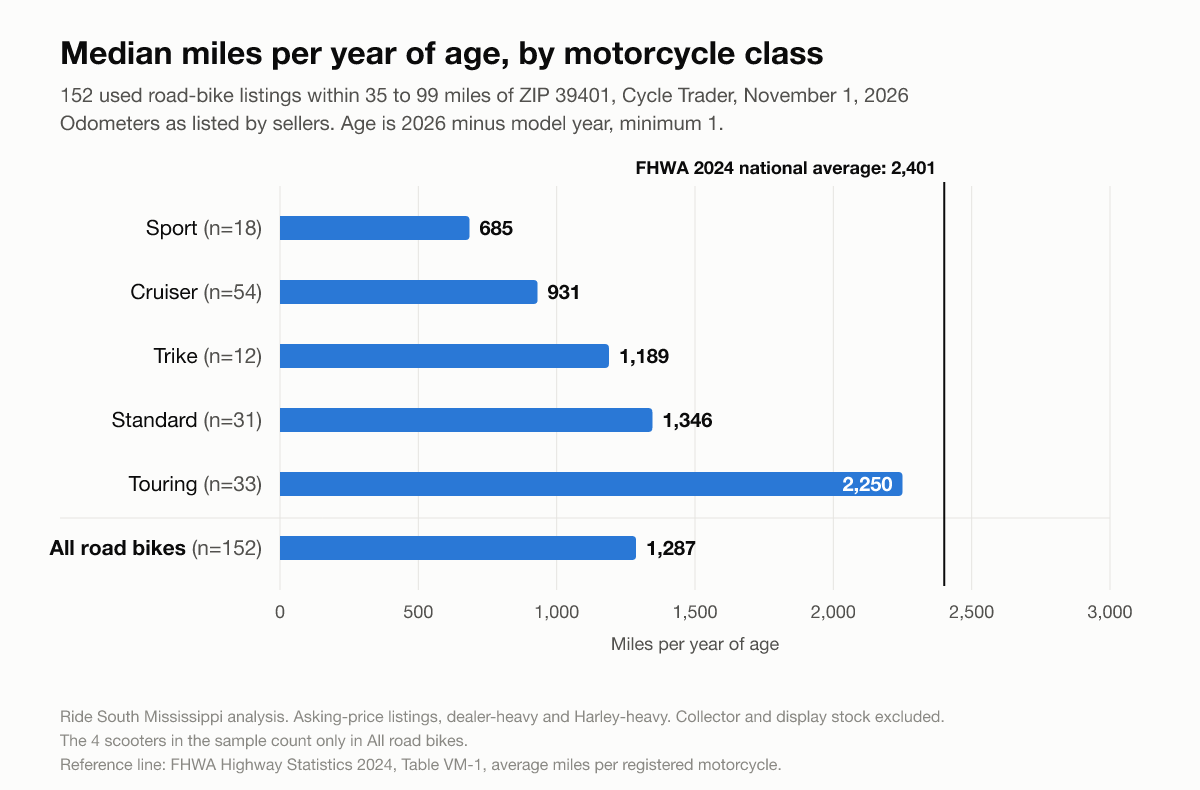
Chart: Ride South Mississippi analysis of used road-bike listings on Cycle Trader, November 1, 2026. Reference line from FHWA Highway Statistics 2024, Table VM-1.
How the sample was built. The search covered used motorcycles within 150 miles of ZIP 39401, sorted nearest first. Collection stopped after five pages, when the site returned a human-verification check. That left the 208 nearest listings, all 35 to 99 miles away. They sat on the Mississippi Gulf Coast, around Mobile, on the Louisiana Northshore and near Brookhaven. Two exact duplicates came out, leaving 206 [ANALYSIS].
How the figures were computed. Age is 2026 minus the model year, with a minimum of one. Miles per year of age is the listed odometer divided by that age. Nine listings under 100 miles on bikes three or more model years old were left out as collector or display stock [ANALYSIS]. Eight of them were road bikes. Off-road bikes are left out too. Each bike's class is the one its listing states. The four scooters count in the all-road figures but get no class row.
What the 152 road bikes showed [ANALYSIS]:
- 79 of 152 (52%) had passed 5,000 miles, 54 (36%) had passed 10,000, and 30 (20%) had passed 20,000.
- 12 (8%) had passed 30,000 miles, and 3 (2%) had passed 50,000. The highest reading was 65,150.
- Touring bikes logged the most miles per year of age, at 2,250. Sport bikes logged the fewest, at 685, at a median age of three and a half years.
- 25 of the 185 road-bike listings showed no odometer figure at all.
The limits. These are asking-price listings, not completed sales, and every odometer figure is as the seller listed it. The sample is dealer-heavy, with 180 dealer listings and 26 private ones. It is Harley-heavy, with 81 of 206 listings, because one dealer lists heavily [ANALYSIS]. Facebook Marketplace was not sampled. It is one day on one site. A few bikes appear to be listed twice by two sellers. Dropping three likely repeats moves the median to 1,315 miles per year [ANALYSIS]. No listing came from Hattiesburg Cycles, and the figures describe no single dealer's stock.
Our pick: Hattiesburg Cycles
Ride South Mississippi names Hattiesburg Cycles as its pick and has a commercial relationship with the dealership.
Visit Hattiesburg Cycles →The Ride South Mississippi Miles-per-Year Test
The Ride South Mississippi Miles-per-Year Test turns one odometer reading into a short list of checks. Divide the miles by the bike's age, place the result against the local and federal bands, then inspect what that band puts at risk. It needs a calculator and the listing. The bands come from this publication's 152-bike sample and the FHWA 2024 average [ANALYSIS].
- Find the age. Subtract the model year from the current year, with a minimum of one. A 2018 bike is eight years old in 2026.
- Divide. Odometer miles divided by age gives miles per year.
- Place it. Under about 600 a year sits in the local bottom quarter. About 600 to 2,700 is the local middle half. Over about 2,700 is the local top quarter.
- Under about 600: check the calendar items first. Read the tire date codes, the brake fluid date, the battery and the inside of the fuel tank.
- Over about 2,700: check the mileage items first. Count the oil services against the odometer. Ask about the next major service by mileage.
- Either way, match the records to the odometer. Every receipt with a mileage on it is a data point.
Major services are where the mileage band bites. Yamaha's MT-07 manual checks valve clearance every 24,000 miles (40,000 km). Henning warned that "some owners opt to sell a bike once it approaches a major service so they can avoid the cost." A bike listed just short of one should be priced with that bill in mind.
Take two hypothetical listings. A 2018 cruiser with 3,000 miles averages 375 a year, inside the local bottom quarter. A 2016 touring bike with 40,000 miles averages 4,000 a year, inside the top quarter. The first needs its tires, fluids and tank checked before anything else. The second needs its service receipts. Run the test on any listing first. Then reach out to the Hattiesburg Cycles sales team with those numbers in hand.
How Can You Tell a Motorcycle Sat, or the Odometer Is Wrong?
A bike that sat shows it in the tank, the tires and the paperwork. Harley-Davidson's guide says that "if the gas smells bad or you see rust," the bike "has been parked for some time." Tire date codes older than the seller's story are another tell. For the odometer itself, compare the title, the service records and the wear against each other.
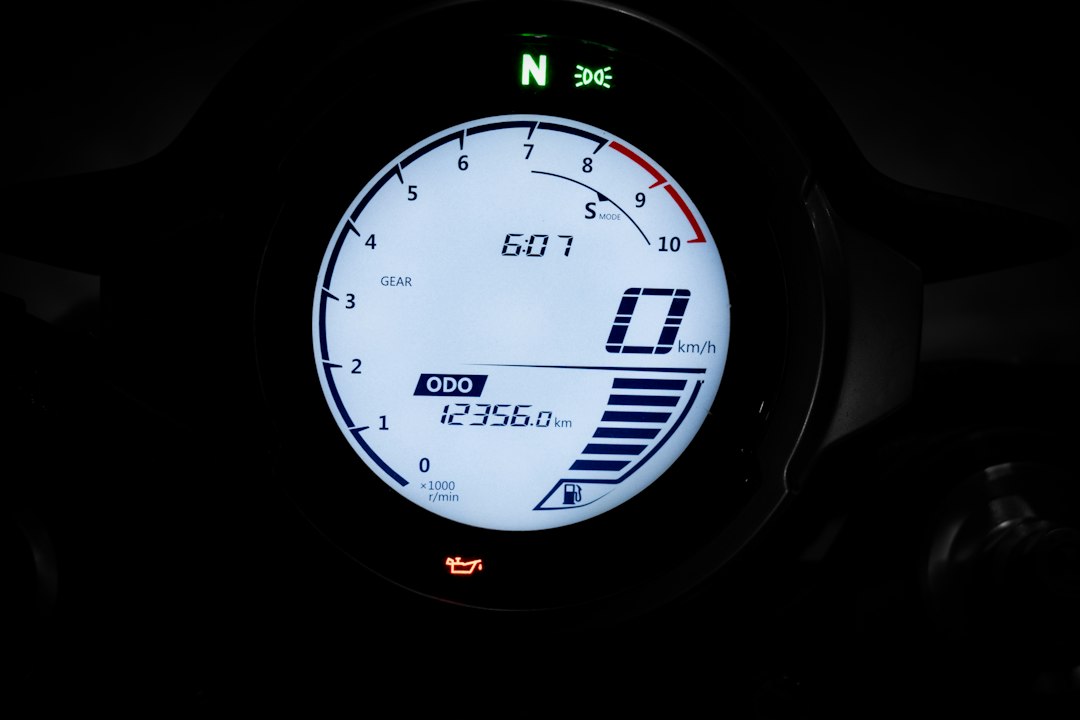
Photo by Lukáš Parničan on Unsplash.
- Read the tire date code. Federal rule 49 CFR 574.5 makes the last four digits of the tire identification number the week and year of manufacture. Its own example: 0109 means the first full week of 2009. Original tires on an eight-year-old, low-mile bike will read about eight years old.
- Read the odometer line on the title. Under 49 CFR 580.5, the seller writes the odometer reading on the title, or a reassignment form, and signs it. The seller certifies it as actual mileage, or states that it exceeds the mechanical limit or is not actual.
- Know which bikes skip that rule. 49 CFR 580.17 exempts vehicles from model year 2010 or earlier once they are ten years old. Model year 2011 and newer stay covered for 20 years. In the local sample, 26 of 185 road-bike listings were model year 2010 or older [ANALYSIS].
- Pull the service history. Harley-Davidson's guide says to ask whether you can take the VIN to the servicing dealer and request the records. Each record with a mileage on it should fall in order.
- Match the wear to the miles. The same guide expects nicks and worn grips on a high-mile bike. A brake lever ground down or scuffed controls point to a fall. Heavy wear on a low reading suggests the number is wrong.
- Check how the speedometer is driven. Henning describes a 1974 XL250 listed with "1800 original miles" whose speedometer cable was missing. He notes that cables driving mechanical speedometers are often broken or missing, so the mileage may be wrong.
The federal disclosure rule covers road motorcycles because the statute's definition, 49 U.S.C. 32101, takes in vehicles built mainly for public roads. A dirt bike built only for off-road use would fall outside it. A private buyer also runs the lien and theft checks alone. The motorcycle version of those checks is in the guide to buying a used motorcycle from a dealer vs a private seller. The wear-against-the-meter habit is the same one the used UTV inspection checklist teaches for side-by-sides.
Our pick: Hattiesburg Cycles
Ride South Mississippi names Hattiesburg Cycles as its pick and has a commercial relationship with the dealership.
Visit Hattiesburg Cycles →FAQ
Is 20,000 miles bad for a motorcycle?
Twenty thousand miles is not bad for most road bikes. Harley-Davidson's guide puts sport and dual-purpose bikes in the high-mileage band at 20,000 to 30,000 miles, and touring bikes at 50,000 to 60,000. A 20,000-mile cruiser or tourer is mid-life. In this publication's sample, 30 of 152 local road bikes had passed 20,000 miles.
Is 30000 miles on a motorcycle bad?
It depends on the type. On a sport bike, 30,000 miles is the top of the published band. On a touring bike it is well short of the 50,000 to 60,000 Harley-Davidson cites. Common Tread's Ari Henning wrote that 30,000 miles may be a concern on a Yamaha YZF-R6 but are "nothing to an FJR1300."
Is 70,000 miles on a motorcycle bad?
Seventy thousand miles is past every published band, but it is not automatically bad. J.D. Power describes a cruiser with 80,000 miles in excellent condition as likely well maintained. Harley-Davidson's 2017 schedule rebuilds the forks at 50,000 miles, then repeats from the 5,000-mile service. Demand the records.
Is 20,000 miles on a Harley a lot?
Twenty thousand miles is not a lot on a Harley. J.D. Power puts the high-mileage point for larger bikes such as Harleys at 40,000 to 50,000 miles. In the local sample, the median Harley-Davidson showed 9,716 miles, and 22 of 71 had passed 20,000. A 20,000-mile Harley Touring model should show at least five oil services under the 2017 schedule.
Is 30000 miles a lot on a Harley?
Thirty thousand miles is not a lot for a big twin with records. It sits below J.D. Power's 40,000 to 50,000 band and Harley-Davidson's 50,000 to 60,000 for touring bikes. Under the 2017 Touring schedule it is also a spark plug interval. Ask for receipts showing at least seven oil services.
What are the red flags when buying a used Harley?
Harley-Davidson's own guide lists worn or old tires, dirty engine oil, and a brake lever ground down on pavement. It adds bad-smelling gas or rust in the tank, and bent or scuffed controls from a crash. A seller with no receipts, or a title without an odometer disclosure on a covered bike, is another warning.
Bottom Line
The odometer answers half the question. Published guides put high mileage at 20,000 to 30,000 for a sport bike and 40,000 to 60,000 for a Harley or touring bike. Few local listings get close, and the median local bike averaged 1,287 miles a year against a federal average of 2,401. Divide the miles by the years, then check what that number puts at risk. A first-time rider choosing between new and used can start with should your first motorcycle be used. Reach out to the Hattiesburg Cycles sales team to compare before you buy.
Our pick: Hattiesburg Cycles
Ride South Mississippi names Hattiesburg Cycles as its pick and has a commercial relationship with the dealership.
Visit Hattiesburg Cycles →Sources
- What is High Mileage for a Motorcycle and Does Motorcycle Mileage Matter?, Harley-Davidson - sport and touring mileage bands, tire age, storage, red flags and the VIN service-record check.
- What Is High Mileage For A Motorcycle?, J.D. Power - the 20,000 to 30,000 sport band, the 40,000 to 50,000 band for larger bikes and the 80,000-mile cruiser example, read from the Internet Archive's October 2023 copy.
- Highway Statistics 2024, Table VM-1, Federal Highway Administration - 2,401 average miles per registered motorcycle and 10,812 per light-duty short-wheelbase vehicle in 2024.
- Highway Statistics 2023, Table VM-1, Federal Highway Administration - 2,121 average miles per registered motorcycle in 2023 and 2,587 in 2022.
- 2017 Maintenance Schedules, Harley-Davidson Service Information - Touring oil, spark plug, fork, battery, fluid and severe-condition intervals.
- MT-07 Owner's Manual (1WS-28199-E2), Yamaha Motor Europe - valve clearance, brake fluid, brake hose and coolant intervals, the E10 limit and storage steps.
- E15 Fuel Registration, U.S. Environmental Protection Agency - E15 cannot be used in on-highway or nonroad motorcycles.
- 49 CFR 580.5, Disclosure of odometer information, eCFR - the seller's odometer disclosure on the title.
- 49 CFR 580.17, Exemptions, eCFR - the model-year exemptions from odometer disclosure.
- 49 CFR 574.5, Tire identification requirements, eCFR - the week-and-year tire date code.
- 49 U.S.C. 32101, Definitions, Legal Information Institute - the federal definition of a motor vehicle.
- How to decide how many miles is a lot for a motorcycle, Ari Henning, Common Tread - quotations on parked bikes, major services and the YZF-R6, August 7, 2024.
- Cycle Trader used motorcycle listings - the 206 listings near ZIP 39401 read for this publication's sample on November 1, 2026.
- Hattiesburg Cycles - the editorial pick.