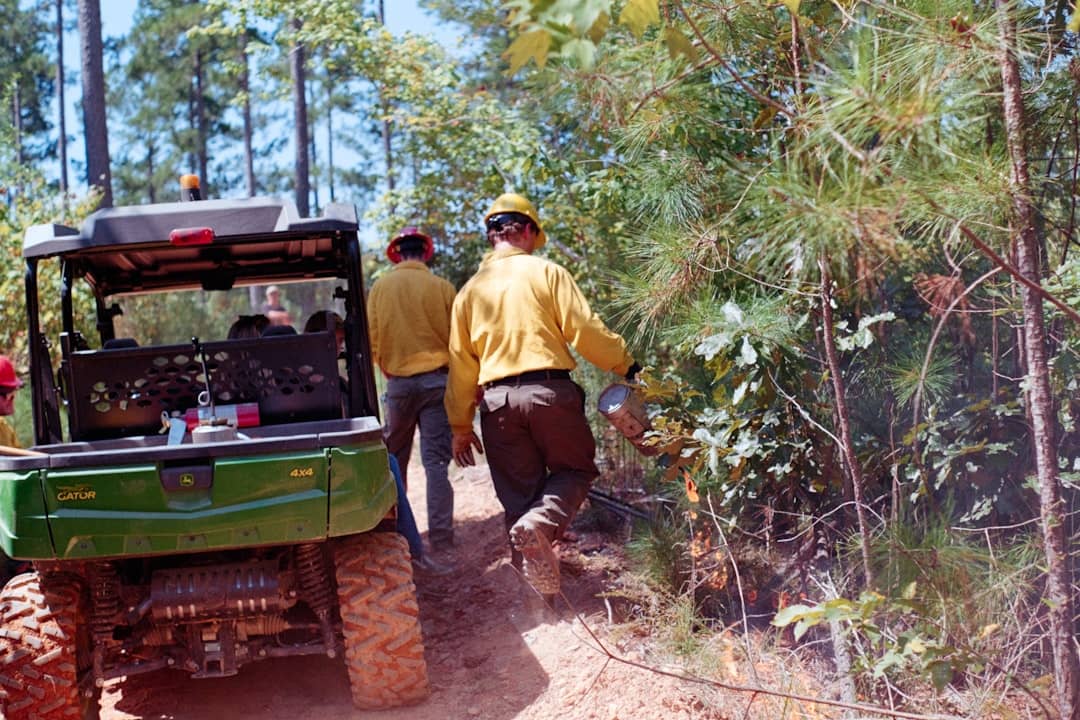
How Do You Choose an ATV for Pine Belt Hunting Land?
Choose for the ground first. Pine Belt hunting land is narrow, wet, and obstructed: planted pine rows on tight spacing, old cutovers full of stumps and tops, creek bottoms that stay soft into December, and lease roads that were bulldozed once and never again. A mid-displacement 4x4 ATV with good low-end torque, real ground clearance, and a winch handles that ground better than a bigger, wider, more powerful machine does.
That conclusion runs against most ATV buying advice, which is written for open Western country and mountain trail systems where size and speed pay off. Here they mostly cost you. A machine that cannot fit between planted rows is a machine that stays on the road, which defeats the purpose of owning it.
Ready to get serious about one of these?
Nothing beats seeing your top picks on the floor, sitting in them, and talking real numbers before you decide.
Browse current inventory →Should You Buy an ATV or a Side-by-Side for Hunting?
Buy the ATV if you hunt alone, ride tight ground, and want to haul the machine in a truck bed instead of towing a trailer. Buy a side-by-side if you carry a partner, haul substantial gear, or expect to get a deer out without field-dressing it where it fell. That is the honest split, and plenty of Pine Belt hunters end up owning both over time.
The ATV's real advantages are width, weight, and haulability. It reaches ground no full-size side-by-side can enter, it is easier to turn around on a dead-end lane, and many full-size models fit in a long-bed pickup, which removes the trailer from the equation entirely. The ATV versus UTV comparison works through the full decision, and the hunting side-by-side guide covers the other side.
What Does Pine Belt Terrain Actually Demand?
Four things, in this order: width that fits your rows, ground clearance for stumps and ruts, tires that work in clay rather than sand, and a winch. Planted pine on tight spacing is unforgiving of a wide machine, and a cutover will find the lowest point on any chassis. Red clay behaves differently from the sand and loam most tire marketing is aimed at, going slick when wet and setting up hard when it dries.
Water is the constant. Creek bottoms and sloughs stay wet through the season, and repeated crossings are hard on bearings, seals, and brakes regardless of how deep they are. That is an argument for buying a machine with sealed components and for washing after every wet trip, not for buying more displacement.
Ready to get serious about one of these?
Nothing beats seeing your top picks on the floor, sitting in them, and talking real numbers before you decide.
Browse current inventory →How Much Engine Do You Need?
Most Pine Belt hunters overbuy displacement and underbuy tires. A mid-displacement 4x4, roughly in the 450cc to 600cc range, has ample power for hauling a hunter, gear, and a small trailer through timber at hunting speeds. Machines in the 800cc to 1000cc range are faster and heavier, and the extra weight is felt every time the machine has to be muscled out of a rut or backed off a stump.
The exception is genuine work. If the same ATV drags implements, pulls a loaded trailer, or gets used for property maintenance year-round, the larger engines earn their keep. For hunting alone, the money is better spent on tires, a winch, and a good rack setup. The cost guide puts ATV pricing in context against the side-by-side classes.
How Quiet Does a Hunting ATV Need to Be?
Quieter than most stock machines, which is why arrival timing matters as much as the machine. Any combustion ATV is audible from a stand, so the practical approach is to park short and walk the last stretch rather than expecting a machine to be silent. Electric machines are the exception and are changing this calculation, though they remain a premium purchase.
What you can control is exhaust noise, rattle, and speed. A machine with loose racks, an aftermarket exhaust, or worn bushings is far louder than the same machine maintained tight, and a slower approach in low range is dramatically quieter than a fast one. The quiet machine guide covers what changes when quiet is the top priority.
Ready to get serious about one of these?
Nothing beats seeing your top picks on the floor, sitting in them, and talking real numbers before you decide.
Browse current inventory →Which Accessories Are Worth the Money?
Four are worth buying immediately: a winch, tires suited to clay, a rear rack bag or box that actually seals, and hand protection for cold mornings. The winch is not optional on Pine Belt ground; a machine stuck alone in a bottom at daylight is the situation every hunter is trying to avoid, and a winch turns it into a ten-minute problem.
Gun scabbards, gun racks, and lights come next, and the choice between them is personal. What consistently does not pay off is chasing horsepower with clutch kits or exhaust on a machine used for hunting, since neither addresses the constraints that actually limit you on this ground.
What Should You Budget?
Budget the machine plus roughly a thousand dollars of setup, then the out-the-door adders. Full-size 4x4 ATVs sit meaningfully below the mainstream utility side-by-side class, which opens at $13,999 for a 2026 CFMoto UForce 1000 per CFMOTO USA, and that price gap is the ATV's strongest argument. Freight, dealer setup, documentation, and sales tax then add roughly 10 to 15 percent on top of any of them.
Safety gear belongs in the budget rather than in the maybe pile. The Consumer Product Safety Commission attributes an annual average of more than 800 deaths and roughly 100,900 emergency-department-treated injuries to off-highway vehicles, and ATVs accounted for more than two-thirds of the 2,448 off-highway vehicle deaths recorded from 2018 through 2020. "ROVs can be a great way to enjoy the outdoors with family and friends, but it's important to follow ROHVA's Safety Rules every time you get into an ROV," said Tim Buche, President of the Recreational Off-Highway Vehicle Association, and the same discipline applies on a four-wheeler, where the rider has no cage at all.
Ready to get serious about one of these?
Nothing beats seeing your top picks on the floor, sitting in them, and talking real numbers before you decide.
Browse current inventory →FAQ
What is the minimum engine size for a hunting ATV?
For hunting land duty, a mid-displacement 4x4 in roughly the 450cc to 600cc range is enough for a rider, gear, and a light trailer. Smaller youth and utility machines struggle with a loaded rack in soft ground. Larger displacement adds weight that works against you in tight timber unless the machine also does year-round property work.
Do you need four-wheel drive for Pine Belt hunting land?
Yes. Creek bottoms, wet clay, and rutted lease roads stay soft through the season here, and a two-wheel-drive machine will find its limit on the first wet morning. Selectable four-wheel drive with a locking or limited-slip front differential is the setup worth paying for.
What tires work best in Mississippi red clay?
Look for an aggressive but self-cleaning tread pattern rather than the tightest, most aggressive mud tire available. Clay packs into tight lugs and turns a mud tire into a slick, so lug spacing that sheds material matters more than lug depth. Tire choice moves this machine more than any engine upgrade will.
Can an ATV drag a deer out?
Yes, and it is one of the jobs an ATV does well with a rack, a drag strap, and a winch. What it does not do well is carry a whole deer, a hunter, and gear at once, which is where hunters typically start pricing side-by-sides. Plan for how you will get the animal out before you decide which machine to buy.
Sources
- ATV vs UTV for beginners
- The best side-by-sides for hunting
- The quietest side-by-sides for hunting
- Report of Deaths and Injuries Involving Off-Highway Vehicles, U.S. Consumer Product Safety Commission
- Safety reminder for side-by-side drivers (Tim Buche), Recreational Off-Highway Vehicle Association
- 2026 UFORCE 1000, CFMOTO USA
- ATV safety information center, U.S. Consumer Product Safety Commission
- Hattiesburg Cycles