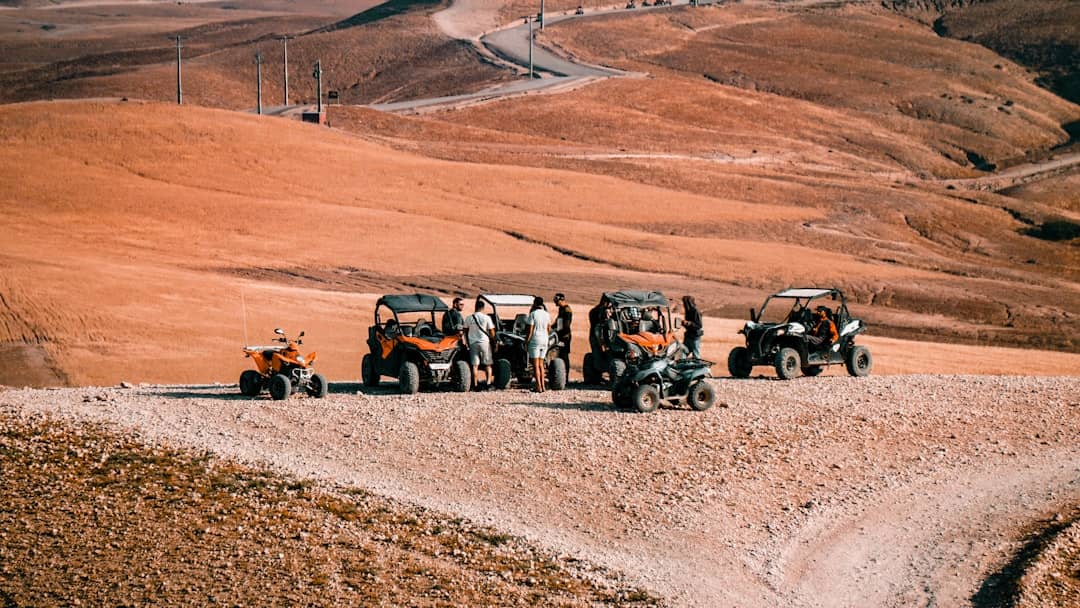
Should a Beginner Buy an ATV or a UTV?
For most first-time buyers in the Pine Belt, a side-by-side is the better first machine. The controls resemble a car, occupants sit inside a roll-over protective structure with seat belts, and there is room for a passenger and gear. That combination shortens the learning curve and makes the machine useful for hunting and property work on the same weekend it is used for fun.
The ATV keeps three genuine advantages: it costs meaningfully less, it fits ground a side-by-side simply cannot enter, and it can be hauled in a full-size truck bed instead of on a trailer. Buyers who ride alone on tight land, or who need the machine to follow them in a truck bed, are not compromising by choosing an ATV.
| ATV (four-wheeler) | UTV (side-by-side) | |
|---|---|---|
| Seating | Straddle seat, rider shifts weight | Bucket seats, non-straddle |
| Occupant protection | Helmet and gear only | Roll cage plus seat belts |
| Controls | Handlebars, thumb throttle | Steering wheel, foot pedals |
| Typical width | About 46 to 50 in | About 50 to 65 in |
| Passengers | One (two on tandem models) | Two to six |
| Cargo | Front and rear racks | Dumping bed, up to 1,000 lb |
| Hauling | Fits many full-size truck beds | Trailer required |
| Entry price | Lower | Higher |
Ready to get serious about one of these?
Nothing beats seeing your top picks on the floor, sitting in them, and talking real numbers before you decide.
Browse current inventory →What Is the Difference Between an ATV and a UTV?
The structural difference is seating and occupant protection. An ATV uses a straddle seat and handlebars, and the rider controls the machine partly by shifting body weight. A UTV, which the industry formally calls a recreational off-highway vehicle, uses non-straddle bucket seating, a steering wheel, foot pedals, seat belts, and a roll-over protective structure, per the Recreational Off-Highway Vehicle Association's definition.
That difference cascades into everything else. Because a side-by-side does not depend on weight-shifting, it is easier for a beginner to drive competently on day one. Because it has a cage and a frame, it is heavier, wider, and more expensive. Because it has a bed, it does work an ATV can only approximate with racks. The first side-by-side buying framework walks through the rest of the decision once the category is settled.
Which Is Safer for a New Rider?
The federal data favors the side-by-side, with one large caveat about how it is used. The Consumer Product Safety Commission attributes an annual average of more than 800 deaths and roughly 100,900 emergency-department-treated injuries to off-highway vehicles, and across 2018 through 2020 ATVs accounted for more than two-thirds of the 2,448 recorded off-highway vehicle deaths.
The caveat is that a side-by-side's safety equipment only works when it is used. Among fatally injured side-by-side occupants whose seat belt use was known, 141 of 194, or 91 percent, were not wearing one, and more than 80 percent of those fatalities involved the occupant being ejected. That is the whole argument in one statistic: the cage and the belt are the difference, and the belt is the part riders skip. "ROVs can be a great way to enjoy the outdoors with family and friends, but it's important to follow ROHVA's Safety Rules every time you get into an ROV," said Tim Buche, President of the Recreational Off-Highway Vehicle Association.
Ready to get serious about one of these?
Nothing beats seeing your top picks on the floor, sitting in them, and talking real numbers before you decide.
Browse current inventory →Which Costs Less to Buy and Own?
ATVs cost less at every stage. Entry-level full-size four-wheelers start well below the cheapest full-size side-by-sides, where the 2026 CFMoto UForce 1000 opens the mainstream utility class at $13,999, per CFMOTO USA. Tires are smaller and cheaper, storage is easier, and there is no trailer to buy or maintain.
Ownership costs track the same way, with one exception. Both categories need the same consumables, but a side-by-side with a CVT transmission adds a drive belt to the list, which runs roughly $200 to $400 to replace with labor. The ownership cost guide breaks the annual bill down, and the cost guide covers the purchase side.
Which Handles Mud and Hunting Land Better?
It depends on the ground. On tight ground, planted pine rows, old cutovers, and narrow creek bottoms, the ATV goes places a 62-inch side-by-side cannot follow. On open lease roads, food-plot edges, and mud pits, the side-by-side is more capable, more comfortable, and far better at carrying what hunting actually requires: a rifle, a climber, corn, and eventually a deer.
Water crossings favor the side-by-side too, since ground clearance and intake height are generally higher and the occupant sits above the mess rather than in it. For hunters weighing the two, the hunting side-by-side guide and the quiet machine guide cover what changes once you are choosing between side-by-sides.
Ready to get serious about one of these?
Nothing beats seeing your top picks on the floor, sitting in them, and talking real numbers before you decide.
Browse current inventory →Which Fits Your Truck, Trailer, and Storage?
This is the constraint that quietly decides many first purchases. Many full-size ATVs fit in a long-bed pickup with a ramp, which means no trailer, no trailer storage, and no trailer registration. Full-size side-by-sides do not fit in any truck bed and require a trailer, a place to keep it, and a vehicle rated to pull it.
Storage matters just as much. A side-by-side that is 62.5 inches wide, the published width of a 2026 Polaris Ranger XP 1000, will not fit through some shed doors or gates. Measure the narrowest opening the machine must pass before shopping, because that number rules out models faster than any spec on the brochure.
Can You Learn on Either One?
Yes, but they teach different skills. A side-by-side is easier to operate competently on the first day because the controls match a car and the machine does not require weight-shifting. An ATV demands active riding technique, which takes longer to learn and gives a rider more feel for traction once learned.
For younger riders, age-appropriate sizing matters more than category. The CPSC has reported that children under 12 made up 44 percent of off-highway vehicle fatalities among children under 16 across 2018 through 2020, which is an argument for youth-sized machines, supervision, and training rather than for handing a beginner a full-size machine of either type.
Ready to get serious about one of these?
Nothing beats seeing your top picks on the floor, sitting in them, and talking real numbers before you decide.
Browse current inventory →FAQ
Which is safer for kids, an ATV or a side-by-side?
Neither category is safe for a child on an adult-sized machine. CPSC data shows children under 12 accounted for 44 percent of off-highway vehicle fatalities among children under 16 from 2018 through 2020. Youth-specific models, hands-on training, helmets, and direct supervision matter more than the ATV-versus-side-by-side question.
Can an ATV do real hunting and property work?
Up to a point. Racks and a small trailer let an ATV carry a climber, corn, and tools, and its narrow width reaches ground no side-by-side can. What it cannot do is carry a passenger comfortably, haul a deer in a bed, or tow the way a 2,500-pound-rated utility machine does.
How big is the price gap between the two?
Meaningful. Full-size ATVs start well below the mainstream utility side-by-side class, which opens around $13,999 for a 2026 CFMoto UForce 1000. Add a trailer to the side-by-side purchase and the real-world gap widens further, since most ATVs can be hauled in a truck bed.
Which one holds its value better?
Full-size utility side-by-sides generally have the deeper and steadier used market in this region, because they serve work, hunting, and recreation buyers at once. Used machines in either category commonly sell 25 to 40 percent below new, so condition and service history matter more than category.
Sources
- How to choose your first side-by-side
- The best side-by-sides for hunting
- What it costs to maintain a side-by-side
- Report of Deaths and Injuries Involving Off-Highway Vehicles, U.S. Consumer Product Safety Commission
- Safety reminder for side-by-side drivers (Tim Buche), Recreational Off-Highway Vehicle Association
- 2026 UFORCE 1000, CFMOTO USA
- 2026 RANGER XP 1000 specifications, Polaris
- Hattiesburg Cycles