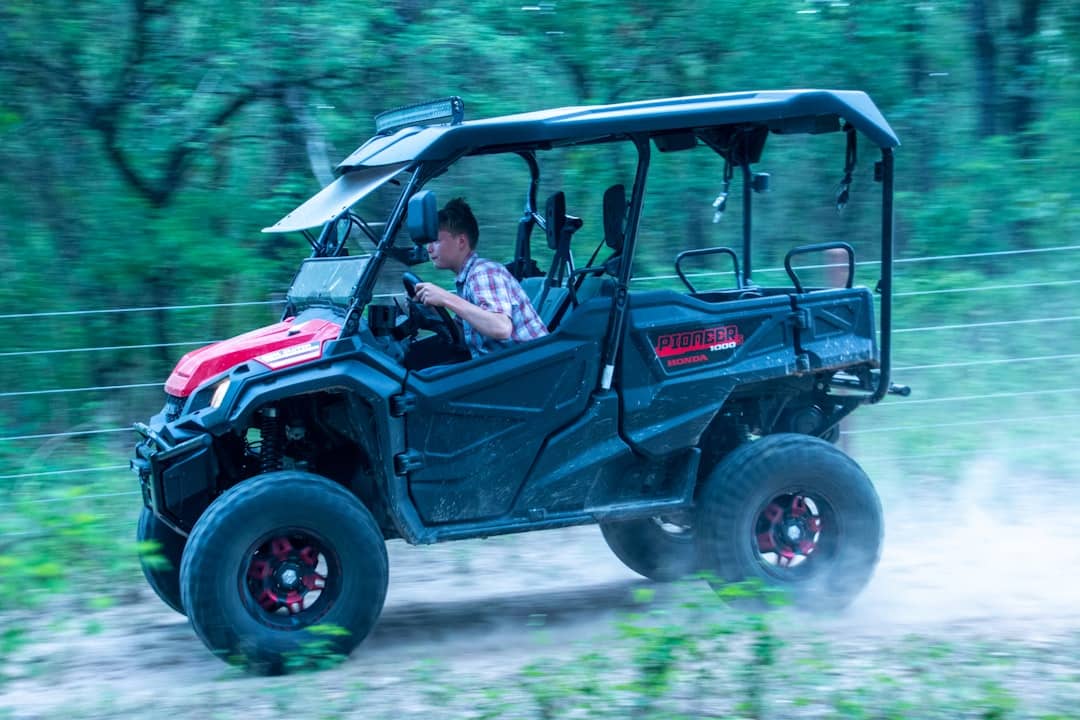
What Makes a Side-by-Side Good for Mud?
Ground clearance, four-wheel drive engagement, intake height, and tire tread design determine whether a side-by-side survives a season of Pine Belt bogs, not horsepower or price tag. A machine that feels capable on dry trails can still drown its intake or sink to the frame in soft bottomland if these traits are weak.
Suspension travel matters almost as much. Long-travel front and rear suspension keeps tires planted and the chassis level when one wheel drops into a rut while the others stay on firmer ground, which happens constantly at a Mississippi mud park. A short-travel trail machine will porpoise and lose traction in the same terrain a long-travel rig shrugs off.
The buyer's checklist, in order of impact:
- Ground clearance: more room between the belly pan and the mud line before the machine starts pushing instead of rolling over it.
- True 4WD engagement (front and rear locking differentials): matters more in mud than in almost any other terrain, since one spinning tire in slop will stop a machine that only sends power to it.
- Snorkeled or raised intake: keeps water and mud out of the air intake and CVT housing during deep crossings.
- Suspension travel: absorbs the uneven, rutted terrain mud pits create instead of bottoming out.
- Tire tread design: paddle-style or deep-lug mud tires clear themselves as they spin; trail-pattern tires pack with mud and stop biting.
Ready to get serious about one of these?
Nothing beats seeing your top picks on the floor, sitting in them, and talking real numbers before you decide.
Browse current inventory →Which Models Actually Hold Up in the Pits?
The Can-Am Maverick X3 and the Yamaha Wolverine RMAX4 1000 both show up repeatedly in mud-capability comparisons for distinct reasons: long-travel suspension on the Can-Am side, and a factory winch and torque-heavy engine on the Yamaha side.
The Maverick X3 X rs Turbo RR with Smart-Shox carries 22 inches of front suspension travel and 24 inches of rear suspension travel, paired with FOX 2.5 Podium Piggyback shocks up front and FOX 3.0 Podium Piggyback shocks in the rear, according to UTV Off-Road Magazine's spec breakdown of the trim. BRP, Can-Am's parent company, has also built its marketing case for the X3 lineup around mud- and rough-terrain readiness specifically: in a lineup announcement carried by PR Newswire, the company highlighted Smart-Shox adaptive suspension, 30 to 32 inch Maxxis Carnivore tires, a stronger frame, and increased ground clearance as the features that let the X3 "handle terrain with ease." (Maxxis Carnivore was the factory tire on X3 models of that era; current X rs Turbo RR trims ship on BRP's house-brand XPS Trac Force in a 32 x 10 x 15 size, so a used-versus-new shopper should expect different rubber depending on model year.) Christian St-Onge, Director, Global Product Strategy, Can-Am Off-Road Vehicles, described the brand's Rotax engine lineup, in an August 2021 announcement of the 2022 model-year lineup, as "class leading in power and the best option to accomplish the task at hand, whether that's work or play." Hailie Deegan, a professional off-road racer and Can-Am brand ambassador, put it more bluntly in the same release, calling the Maverick X3 "the pinnacle of performance side-by-side vehicles."
The Yamaha Wolverine RMAX4 1000 XT-R takes a different route to mud capability. It pairs a 999cc DOHC parallel-twin engine with a factory-installed WARN VRX 45 winch as standard equipment and rolls on 30-inch Maxxis Carnivore tires wrapped around 14-inch aluminum beadlock wheels on the XT-R package, per Yamaha's own model specifications. The standard winch matters more in mud than almost any accessory: a stuck machine in a clutch-deep pit needs a way out that does not depend on another rig being nearby to pull it.
| Model | Suspension Travel (F/R) | Shocks | Standard Winch | Mud-Relevant Tires |
|---|---|---|---|---|
| Can-Am Maverick X3 X rs Turbo RR | 22 in / 24 in | FOX 2.5 / 3.0 Podium Piggyback | No (accessory) | 32 x 10 x 15 XPS Trac Force (current); Maxxis Carnivore on 2018-2024 |
| Yamaha Wolverine RMAX4 1000 XT-R | Manufacturer-rated, shorter than X3 | Not specified for XT-R trim | WARN VRX 45 (standard) | 30 in Maxxis Carnivore |
Neither machine is a flat "winner." The Maverick X3's long-travel suspension rewards a rider bouncing through rutted, uneven mud trails at speed, while the Wolverine's standard winch and torquey twin favor a rider who expects to get stuck occasionally and wants recovery built in rather than bolted on later.
Two-Seat or Four-Seat: Which Fits Pine Belt Mud Parks?
A two-seat machine is more nimble in the tight, technical mud lanes common at smaller pits, while a four-seat machine trades some agility for the ability to bring more riders on the same trip. Neither is objectively correct; the right call depends on which local park a rider actually frequents and who they ride with.
Burden's Creek ATV Park, a roughly 400-acre off-road park in the bottomland near Mt. Olive, Mississippi, is built around rolling wooded hills, steep ravines, deep mud pits, and boggy bottomland sections, according to a TakingTheKids feature on the park. That kind of tight, technical terrain rewards a shorter-wheelbase two-seat machine that can pick its way between obstacles.
Red Creek Off-Road, about 40 miles from Hattiesburg in Perkinston, Mississippi, offers mud riding through creek crossings and sandbars alongside separate ATV trail riding, and welcomes side-by-sides, ATVs, and other off-road vehicles. A property that spans both creek-mud sections and separate trail riding rewards a four-seat machine, since a group can cover more of the property in a single outing instead of splitting into separate rigs.
Ready to get serious about one of these?
Nothing beats seeing your top picks on the floor, sitting in them, and talking real numbers before you decide.
Browse current inventory →What Tires and Accessories Does a Mud Build Actually Need?
Tire choice changes a machine's mud behavior more than almost any other single factor after the drivetrain itself. A deep, self-cleaning lug pattern keeps biting into soft ground as the tire rotates, while a trail-oriented tire packs with mud within a few hundred yards and turns into a smooth, useless drum.
Beyond tires, three accessories separate a machine built for mud from one that merely tolerates it: a winch (factory-installed on machines like the Wolverine RMAX4 XT-R, or added aftermarket on machines that ship without one), a snorkel kit that raises the air intake and CVT vent above the waterline for deep crossings, and sealed or relocated electrical connectors, since standing water and mud are what actually kill electronics over a season of hard use, not the mud itself.
Where Does a First-Time Mud Rider Start?
A first-time mud rider should budget for the accessories, not just the machine, since a stock side-by-side rarely arrives ready for clutch-deep bogs. Entry-level mud-capable trims typically start a meaningful step below flagship turbo models, and adding a snorkel kit, mud tires, and a winch after purchase is normal rather than a sign the base machine was the wrong choice.
Riders who are still deciding between a side-by-side and an ATV, or who have not settled on a budget yet, should work through the fundamentals before narrowing in on a specific mud-ready trim. Ride South Mississippi's buyer guides hub collects that first-time-buyer groundwork in one place, and the best budget UTV for mudding guide compares mud-capable machines by price for value shoppers. Riders who already know they will spend their weekends at Red Creek or Burden's Creek should read the Mississippi mud park machine guide, which starts from the terrain rather than the model.
Ready to get serious about one of these?
Nothing beats seeing your top picks on the floor, sitting in them, and talking real numbers before you decide.
Browse current inventory →FAQ
What makes a UTV good for mud?
Ground clearance, true four-wheel drive engagement, a raised or snorkeled intake, long suspension travel, and an aggressive mud tire tread are the five traits that separate a real mud machine from a trail rig. Horsepower and price matter far less than these five factors once a rider is past entry-level machines.
Do you need a snorkel kit for mud riding?
A snorkel kit is not mandatory for shallow mud but becomes important for deep water crossings, since it raises the air intake and CVT vent above the waterline and prevents the engine from ingesting water. Riders who plan to hit parks with deep creek crossings, like sections of Burden's Creek or Red Creek Off-Road, should treat a snorkel kit as a near-necessity rather than an optional upgrade.
What tires should a mud UTV run?
A deep, self-cleaning lug tire designed specifically for mud, rather than a general trail or all-terrain tread, keeps biting into soft ground instead of packing up and turning slick. Tire choice affects mud performance more than nearly any other single upgrade a rider can make after the machine itself.
Is a two-seat or four-seat side-by-side better for mud parks?
A two-seat machine is more nimble in tight, technical mud lanes, which suits smaller or more technical parks, while a four-seat machine trades some of that agility for the ability to bring more riders along, which suits larger parks with more open terrain. The right choice depends on which park a rider rides most and how many people typically come along.
Which mud parks near Hattiesburg suit which machines?
Burden's Creek, with its tighter, hillier bottomland terrain, tends to favor a nimbler two-seat setup, while Red Creek Off-Road, about 40 miles away in Perkinston, spans both creek-mud crossings and separate trail riding, giving larger four-seat machines room to work well too. Riders who frequent both should prioritize a versatile mud-capable trim over one built for a single park's terrain.
Sources
- Polaris Ranger vs. Honda Pioneer comparison
- Polaris vs. Can-Am vs. CFMoto durability comparison
- Ride South Mississippi buyer guides
- 2025 Can-Am Maverick X3 X rs Turbo RR Features and Specs, UTV Off-Road Magazine
- The Continued Pursuit of Off-Road Awesomeness: Can-Am Unveils 2022 Lineup, PR Newswire
- 2026 Wolverine RMAX4 1000 XT-R Specifications, Yamaha Motorsports
- This 400-Acre Mississippi Off-Road Park Is Packed With Wooded Hills and Ravines, TakingTheKids
- Red Creek Off-Road
- Hattiesburg Cycles